
What is GLP Certification and Why It Matters for Your Testing Partner

Introduction
When you send your product samples to a testing lab, you are trusting that lab with something critical — the accuracy of your data.
That data decides whether your product gets regulatory approval, passes an audit, or clears an export shipment. So the question is not just "which lab is nearest" or "which lab is cheapest."
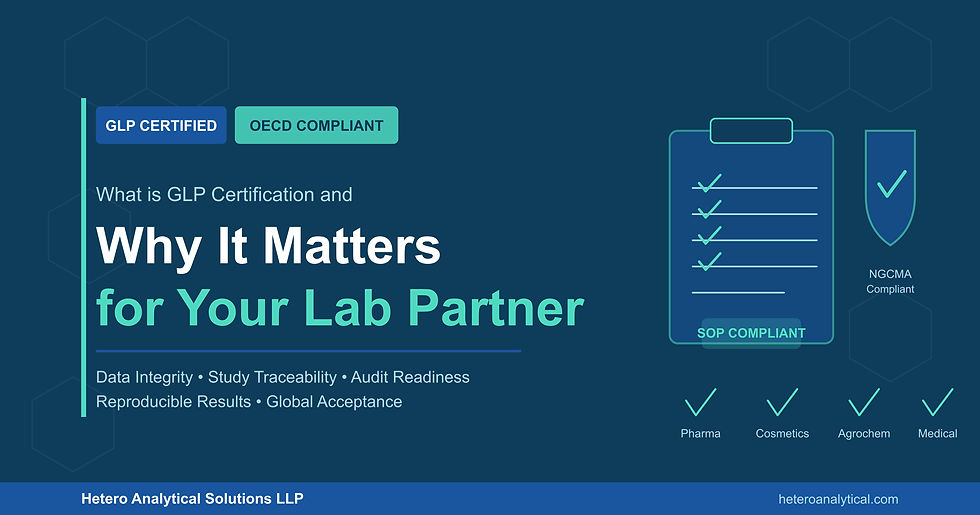
The real question is — does this lab follow the right practices to ensure my results are reliable?
That is exactly what GLP certification testing partner is about.
What is GLP?
GLP stands for Good Laboratory Practice. It is a quality management system that defines how non-clinical laboratory studies should be planned, conducted, recorded, reported, and archived.
In simple terms — GLP is a set of rules that ensures a lab operates honestly, systematically, and in a way that produces results that can be trusted and verified.
GLP was originally developed by the OECD (Organisation for Economic Co-operation and Development) in response to cases where laboratories were found to have falsified or mishandled safety test data. Since then, it has become a globally accepted standard for laboratory quality.
In India, GLP compliance is overseen by the National GLP Compliance Monitoring Authority (NGCMA), established by the Department of Science and Technology, Government of India.
GLP vs ISO/IEC 17025 — What is the Difference?
Many manufacturers get confused between GLP and ISO/IEC 17025. Here is a simple comparison:
ISO/IEC 17025 covers the technical competence of a lab — its methods, instruments, and personnel. It is for testing and calibration laboratories broadly.
GLP focuses specifically on the integrity of non-clinical safety studies — how data is generated, documented, and reported. It is more focused on study design, data traceability, and archiving.
Both together — as in the case of Hetero Analytical Solutions LLP — give you maximum confidence in the quality and integrity of your test results.
What Does GLP Certification Actually Mean for a Lab?
A GLP certified lab must demonstrate:
Proper Study Management Every study must have a designated Study Director who is responsible for the overall conduct and documentation of that study. Nothing is done casually.
Standard Operating Procedures (SOPs) Every activity in the lab — sample handling, instrument use, data recording, waste disposal — must follow a written and approved SOP. No shortcuts, no improvisation.
Data Integrity and Traceability All raw data must be recorded accurately, with dates, signatures, and no unauthorised changes. Every result must be traceable back to the original data.
Quality Assurance Unit An independent QA team within the lab regularly audits studies and processes to ensure GLP compliance. This is an internal check system.
Equipment Calibration and Maintenance All instruments used in studies must be calibrated, maintained, and documented. No expired calibrations.
Archiving of Records All study data, reports, and raw records must be archived securely for a specified period — so that results can be verified even years later.
Why Does GLP Matter When Choosing a Testing Partner?
Here is the practical impact for your business:
Your regulatory submissions are stronger CDSCO, FDA, and international regulatory bodies give more weight to data generated under GLP conditions. A GLP certified lab's reports carry more credibility during product approvals.
Your audit results are cleaner During WHO GMP, customer, or internal audits — auditors check the source and integrity of your test data. A GLP certified lab's documentation is complete, traceable, and audit-ready.
Your export documentation is accepted internationally India's GLP program is aligned with OECD principles, which means GLP certified data is accepted by regulatory authorities in OECD member countries — covering most of your export markets.
Your results are reproducible GLP ensures that if the same study were repeated — by the same lab or a different one — the results would be consistent. This reproducibility is what regulatory bodies look for.
You are protected from data disputes Complete documentation means if a result is ever questioned — by a buyer, an auditor, or a regulator — the lab can demonstrate exactly how, when, and by whom the test was conducted.
Who Needs GLP Certified Testing?
GLP is particularly important for:
Pharmaceutical manufacturers — drug safety studies, API testing, stability data
Cosmetics and personal care — safety and efficacy testing
Agrochemical companies — pesticide safety data for registration
Food additive manufacturers — safety studies for regulatory submissions
Medical device manufacturers — biocompatibility and chemical safety
Chemical manufacturers — industrial chemical safety data
If your product needs regulatory approval before it can be marketed — you need a GLP certified testing partner.
Hetero Analytical Solutions LLP — GLP Certified Lab in Ahmedabad
Hetero Analytical Solutions LLP is GLP certified and operates from Changodar, Ahmedabad, Gujarat. Our GLP certification — combined with NABL accreditation under ISO/IEC 17025:2017 — means every study we conduct follows strict documentation, data integrity, and quality assurance standards.
Whether you need chemical testing, microbiology testing, stability studies, or instrumentation analysis — our results are reliable, traceable, and accepted by regulatory bodies across India and internationally.
Conclusion
GLP certification is not just a credential on a lab's wall. It is a commitment to doing things the right way — every time, for every study, for every client.
When you choose a GLP certified lab as your testing partner, you are protecting your product, your regulatory approvals, and your business reputation.
📍 Hetero Analytical Solutions LLP | Changodar, Ahmedabad, Gujarat 📞 +91 98166 18822 | 🌐 heteroanalytical.com


Comments